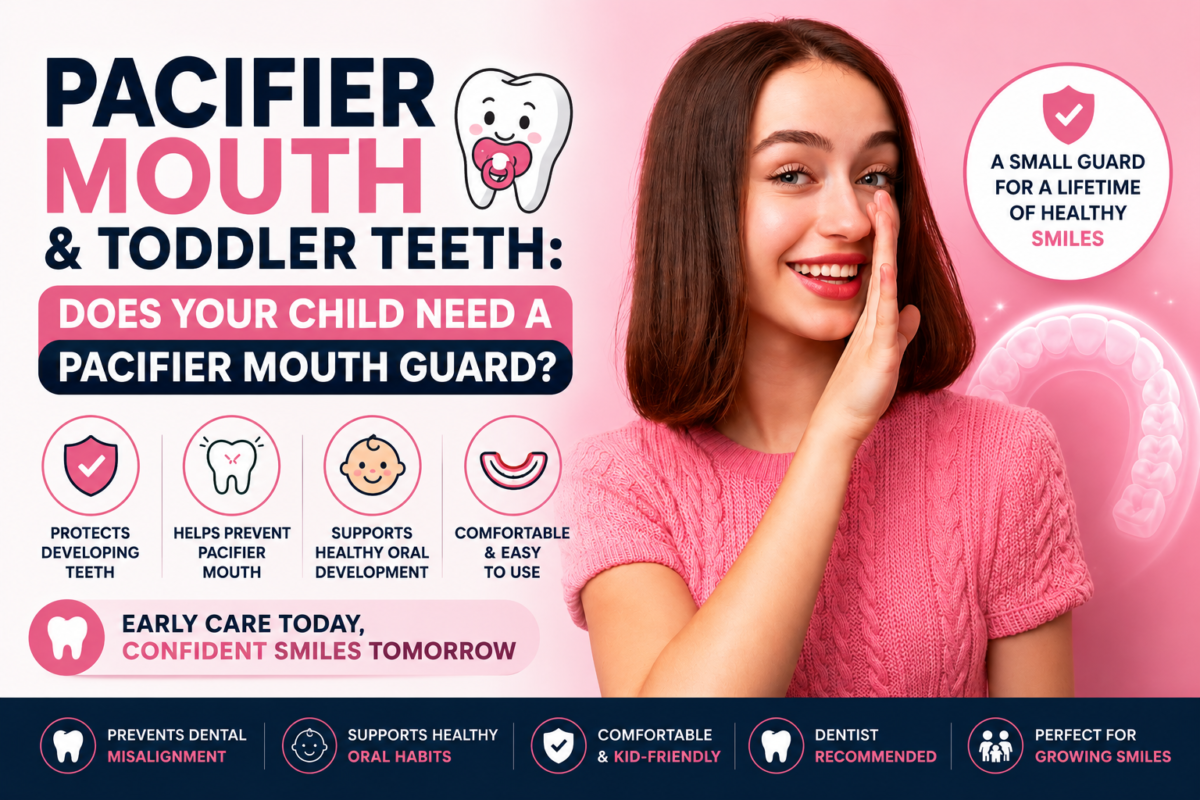
Pacifier Mouth & Toddler Teeth: Does Your Child Need a Pacifier Mouth Guard?

Pacifiers can feel like a parenting lifesaver. They soothe a fussy baby, help with sleep, and offer comfort in stressful moments. But as your little one grows, you might start noticing changes in their mouth or teeth — and wondering if that pacifier is starting to do more harm than good.

If you’ve ever searched “pacifier mouth” or worried about your toddler’s teeth shifting, you’re not alone. Many parents face this exact concern. The good news is, with the right information and a few simple steps, you can protect your child’s smile without too much stress. Here’s everything you need to know about how pacifiers affect toddler teeth, and whether a pacifier mouth guard might help.

What Is “Pacifier Mouth”?

“Pacifier mouth” is a term used to describe changes in a child’s mouth or bite caused by long-term pacifier use. Over time, constant sucking can shift the way teeth grow and how the upper and lower jaws fit together.

Common signs of pacifier mouth include:

  • Front teeth that stick out (sometimes called “buck teeth”)
  • An open bite where the top and bottom front teeth don’t meet
  • Crossbite where the upper and lower teeth don’t line up correctly
  • A narrowed upper jaw or roof of the mouth
  • Crooked or crowded baby teeth
  • Speech development issues

These changes don’t happen overnight — but they can become noticeable in toddlers who use pacifiers heavily past the age of two.

How Pacifiers Affect Toddler Teeth

Babies are born with a natural sucking reflex. It soothes them, helps them sleep, and even aids digestion. But as your child grows, that same sucking motion can start affecting the development of their mouth and teeth.

Here’s what happens during prolonged pacifier use:

  • The constant pressure pushes the front teeth outward
  • The roof of the mouth narrows from the pacifier’s shape
  • The lower teeth may tilt inward
  • The jaw alignment can shift over time
  • The bite pattern becomes harder to correct later

The longer and more often a toddler uses a pacifier, the higher the risk of these changes becoming permanent.

At What Age Does a Pacifier Affect Teeth?

This is the question every parent wants answered — and the honest answer is, it depends on usage.

Here’s a general guide based on dental research:

  • 0 to 12 months: Pacifier use is usually safe and helpful for soothing
  • 12 to 24 months: Mild impact possible if pacifier use is constant
  • 24 to 36 months: Changes to teeth and bite may begin to appear
  • 3 years and older: Risk of permanent dental issues becomes much higher

Most dentists agree that pacifier use should be limited or stopped between ages 2 and 4. Beyond that age, dental changes become more difficult to reverse without orthodontic treatment later.

Signs Your Toddler’s Pacifier Is Affecting Their Teeth

If you’re not sure whether the pacifier is affecting your child’s smile, keep an eye out for these early signs:

  • Front teeth that look more forward than the bottom teeth
  • A gap between the upper and lower front teeth when biting down
  • A narrow or high arched roof of the mouth
  • Trouble pronouncing certain sounds like “s” or “th”
  • Lips that don’t close fully at rest
  • Difficulty chewing properly

If you notice any of these signs, it’s a good idea to schedule a dental checkup.

Does Your Child Need a Pacifier Mouth Guard?

A pacifier mouth guard is a small dental device designed to either help wean a child off a pacifier or protect their teeth from further damage. They’re sometimes recommended by dentists for toddlers who are heavily attached to a pacifier and showing early signs of bite issues.

Here’s how a pacifier mouth guard can help:

  • Prevents teeth from shifting further outward
  • Encourages proper jaw alignment
  • Reduces the urge to suck on a pacifier or thumb
  • Helps transition away from pacifier dependency
  • Protects against open bite or overbite

However, a pacifier mouth guard isn’t always the first solution. In most mild cases, gently weaning your child off the pacifier is enough. A guard becomes more useful when:

  • Your child can’t break the pacifier habit on their own
  • Dental changes have already started
  • Your dentist specifically recommends one
  • The child also has a thumb-sucking habit

Always consult your pediatric dentist before using any oral appliance for your toddler.

Tips to Help Your Toddler Stop Using a Pacifier

Weaning a child off a pacifier can feel overwhelming, but there are gentle ways to make the process easier. Try these tried-and-true tips:

  • Start by limiting pacifier use to nap time and bedtime only
  • Offer comfort items like a soft blanket or stuffed toy
  • Distract your child with play and engagement during the day
  • Praise and reward your child for time spent without it
  • Try the “pacifier fairy” trick where the fairy takes it away in exchange for a small gift
  • Slowly cut down on use over a few weeks
  • Don’t go cold turkey unless your child is ready

Patience is key. Most toddlers can give up the pacifier within a few weeks with the right approach.

How to Protect Your Child’s Teeth During Pacifier Use

If your child is still using a pacifier, there are ways to lower the dental impact:

  • Choose an orthodontic pacifier shaped to support jaw development
  • Avoid dipping the pacifier in sugar, honey, or sweetened drinks
  • Clean the pacifier regularly to prevent bacteria buildup
  • Replace it often as the rubber gets worn down
  • Never tie it around your child’s neck
  • Schedule your toddler’s first dental visit by their first birthday

These small steps can go a long way in protecting your child’s smile.

When to Take Your Toddler to the Dentist

If you’re worried about how a pacifier might be affecting your toddler’s teeth, don’t wait. A dental checkup can give you peace of mind and catch problems early. Visit a dentist if:

  • Your child is over two and still uses a pacifier daily
  • You notice their bite or teeth shifting
  • They have trouble with speech or chewing
  • You’re trying to wean and need professional advice
  • You’re considering a pacifier mouth guard

Pediatric dental visits are gentle, friendly, and designed to make kids feel comfortable from the start.

Frequently Asked Questions

At what age should I stop giving my child a pacifier?

Most dentists recommend stopping pacifier use between ages 2 and 4. After age 3, the risk of dental and jaw changes becomes much higher.

Can pacifier mouth go away on its own?

Mild cases of pacifier mouth can sometimes correct themselves once the pacifier is removed — especially if it’s stopped before age 3. More noticeable changes usually need dental or orthodontic help.

Are orthodontic pacifiers really better for teeth?

Yes, orthodontic pacifiers are shaped to support natural jaw development and are gentler on a baby’s mouth. However, they still cause issues if used long-term or excessively.

Is thumb sucking worse than using a pacifier?

Thumb sucking is often harder to stop because a thumb is always available. Pacifiers, on the other hand, can be taken away, which makes them slightly easier to manage when it’s time to wean.

Should I get a pacifier mouth guard for my child?

Only if your pediatric dentist recommends one. For most toddlers, gentle weaning techniques work well. A mouth guard may be helpful if your child can’t break the habit or if dental changes have already begun.

If you’re worried about pacifier mouth or how your toddler’s teeth are developing, schedule a visit with Ethos Modern Dental & Implant Center. Dr. Sreelakshmi Keesara offers gentle, kid-friendly dental care to help your little one grow up with a strong, healthy smile.

Early Oral Health Problems Dentists Can Detect During Checkups

Most people walk into a dental checkup thinking it’s just about getting their teeth cleaned. You sit in the chair, a hygienist scrapes around for a bit, the dentist pokes at a few teeth, and you’re out the door in forty-five minutes. Simple enough, right?

But here’s what most people don’t realize — that routine visit is doing a lot more than keeping your smile polished. Your dentist is quietly running through a mental checklist that goes far beyond cavities. They’re looking for early stage oral indicators that, if caught now, can save you from a lot of pain, cost, and regret later.

Let me walk you through what’s actually being spotted during those checkups — and why showing up consistently is one of the smartest things you can do for your health.

The Cavity That Doesn’t Hurt Yet

You know the cavities you feel — the sharp zing when you bite into something cold, the dull ache that won’t go away. Those cavities have already had time to do damage.

What dentists are hunting for are the ones you can’t feel yet. Early-stage tooth decay often has no symptoms at all. There’s no pain, no sensitivity, nothing. But under a dental exam with proper lighting, instruments, and sometimes X-rays, a dentist can see the earliest breakdown of enamel — a soft spot, a subtle discoloration, a tiny fissure that’s about to become something much worse.

Catching decay at this stage changes everything. Instead of a root canal or a crown, you might need a small filling. Sometimes you don’t need a filling at all — just a fluoride treatment and a conversation about your diet. That’s the entire value of early detection dental care with dental exams. You turn a potential $1,500 procedure into a $100 one, or into nothing at all.

Gum Disease Hiding Below the Surface

Here’s an uncomfortable truth: gum disease is the leading cause of tooth loss in adults, and most people who have it don’t know.

During a dental exam, your dentist or hygienist measures the pockets around your teeth with a small probe. Healthy gum tissue sits snug against the tooth. But when those pockets start deepening — when the numbers being called out during your exam go from 2s and 3s to 4s and 5s — that’s a sign that gum disease is quietly setting in.

The tricky thing about gum disease is how manageable it is when caught early versus how devastating it becomes when ignored. In its earliest stage, called gingivitis, your gums might just bleed a little when you floss. That’s reversible. But let it progress to periodontitis, and you’re looking at bone loss, teeth that shift and loosen, and eventually extractions.

The benefits of early problem detection in dentistry are nowhere more clear than with gum disease. A few extra cleanings a year versus losing your teeth — there’s no comparison.

Oral Cancer Screening Is Part of the Visit

This one surprises people. Dentists are trained to screen for early signs of oral cancer as part of a routine checkup, and yet most patients have no idea this is happening.

During your exam, your dentist visually inspects your lips, tongue, cheeks, the floor of your mouth, and the back of your throat. They’re looking for unusual patches — white, red, or mixed — sores that haven’t healed, lumps, or any tissue that just doesn’t look right. They’ll also feel along your jaw and neck checking for swollen lymph nodes.

Oral cancer has a survival rate that drops dramatically when it’s caught late. The early detection of dental issues like these — lesions, abnormal tissue changes — gives patients a fighting chance. A suspicious spot found at a checkup can be biopsied quickly and treated before it spreads. This is exactly why skipping “just one” annual visit can carry more risk than people think.

Teeth Grinding You Don’t Know About

A significant number of people grind their teeth at night. They wake up, go about their day, and have no idea it’s happening. Their partner might hear it. Their dentist definitely sees it.

The wear patterns on your teeth are a clear giveaway. Flattened cusps, chipped edges, enamel that’s eroding in a very specific way — these are all early stage oral indicators of bruxism, the clinical term for grinding and clenching. Left unaddressed, bruxism cracks teeth, damages restorations, causes jaw pain, and contributes to headaches that people often blame on stress or screens.

Catching it early means a simple custom night guard can protect your teeth before serious damage is done. If you’re experiencing jaw tightness or morning headaches, it’s worth bringing up at your next visit — or better yet, scheduling a dental exam to get a proper look at what’s going on with grinding and clenching.

Infections That Feel Like Nothing — Until They Do

A dental abscess doesn’t always announce itself with dramatic pain. Some infections sit quietly at the root of a tooth, slowly brewing, visible on an X-ray long before they cause acute symptoms. By the time there’s throbbing pain and facial swelling, the infection has had time to grow, and the treatment required becomes far more involved.

This is where routine X-rays earn their place in a dental visit. Some patients push back on X-rays — understandably, they want to limit exposure. But modern dental X-rays use a fraction of the radiation they once did, and the information they provide is irreplaceable. An early-detected abscess can often be treated with a straightforward root canal treatment and a crown. An abscess that’s been ignored can become a medical emergency.

Early detection dental care isn’t just about your teeth — it’s about keeping a localized problem from becoming a systemic one.

The Cost of Waiting

Here’s the honest truth about dental care: problems don’t pause while you decide whether to book an appointment. They progress. Quietly, steadily, and often without a single symptom until they’ve become something that’s going to take real time and real money to fix.

Tooth pain that sends you searching for an emergency dentist on a Sunday night is almost always something that started as a much smaller issue months ago. That’s not bad luck. That’s what happens when early-stage oral indicators get skipped over because there were no checkups to catch them.

Routine dental visits — every six months, or as recommended — aren’t about finding something wrong. They’re about making sure small things don’t become big ones. They’re about keeping your teeth for your whole life, not just for now.

Your Next Checkup Is Worth More Than You Think

Whether it’s been six months or six years — the single best thing you can do today is book an appointment.

Not because something is wrong. But because a dentist can check whether something might go wrong, and catch it before it does.

Whether it’s an early cavity, the first signs of gum disease, a suspicious patch of tissue, or wear patterns from grinding, a comprehensive dental exam is where those problems get found — quietly, before they become your problem.

Don’t wait for the pain to show up. That’s not when you go to the dentist. Now is when you go to the dentist.

10 Effective Treatments for Tooth Sensitivity That Really Work

The first indication that you might have necessitated proper treatment for sensitive teeth is when you feel a sudden jolt of pain when drinking cold water or biting into ice cream; that is only a reason for avoiding these two food products. Habits such as grinding-clenching can further contribute to enamel wear and increase tooth sensitivity over time. Dentin has many tiny tubes running through it that connect directly to the nerve of each tooth, so cold, hot, sugary foods can cause immediate pain.

Fortunately, once the reason for tooth sensitivity is diagnosed, tooth sensitivity typically can be treated very effectively. In most cases, your dentist will be able to identify specifically what has caused your tooth sensitivity and recommend treatments for you that will provide long-lasting relief.

One of the best ways to explain how you can help your sensitive teeth is with the acronym CALM:

  • – Cover the exposed area
  • – Change habits you have that are causing you to have sensitive teeth
  • – Decrease exposure of your teeth to acids
  • – See a dentist to get the source of your sensitivity treated professionally

Why Tooth Sensitivity Should Never Be Ignored

Tooth sensitivity is one of the most common dental problems, but many people ignore it until the pain becomes difficult to manage. Unfortunately, sensitivity rarely improves on its own. When dentin remains exposed, triggers continue reaching the nerve and the tooth gradually becomes weaker. In many cases, persistent tooth pain can also develop as the sensitivity worsens over time.

The goal of proper tooth sensitivity treatment is not simply to numb the discomfort temporarily. Real treatment helps protect or rebuild damaged areas so sensitivity becomes less frequent and less severe over time.

Cover the Exposed Surface

The quickest way to decrease sensitivity is by shielding exposed dentin from outside stimuli, and sending stimuli out of the way before they reach the nerve. 

In addition to desensitising toothpaste, most dentists will recommend using desensitising toothpaste to their patients with mild or moderate sensitivity, as this is often considered an effective treatment. To obtain the optimum effect from this type of toothpaste do the following:

  • -Brush your teeth twice a day on a regular basis.
  • -Use this toothpaste for a minimum of 2 – 4 weeks.
  • -Apply a minimal amount of toothpaste directly to the sensitive area of your  teeth just prior to going to bed.

Most individuals will experience a gradual lessening of their sensitivity when using desensitising toothpaste on a continuous basis.  For these reasons, this is one of the easiest solutions to fixing sensitive teeth at home.

Get a Professional Fluoride Treatment

Water-based fluoride varnishes and gels, applied by dentists, provide a stronger protective barrier for sensitive teeth than other forms of toothpaste or other types of fluoride treatments. When applied directly to the tooth surface, these products can help to strengthen the enamel on that tooth and seal off any areas of exposed dentin underneath the surface.

Fluoride varnish or gel treatment is particularly effective for individuals with:

  • – Generalized sensitivity
  • – Early enamel erosion
  • – Sensitivity following dental cleanings or whitening

For some individuals, multiple applications of fluoride may be needed in order to produce long-term benefits.

Adjust the Habits Wearing Down Your Teeth

Daily habits play a major role in tooth sensitivity. Correcting these habits can significantly reduce discomfort and prevent further enamel damage.

Use a Soft-Bristled Toothbrush

Brushing too aggressively is one of the most common causes of enamel wear and gum recession. A hard-bristled toothbrush combined with excessive pressure slowly removes the tooth’s protective surface.

To brush more safely:

  • Use a soft-bristled toothbrush
  • Brush with gentle circular motions
  • Avoid scrubbing back and forth aggressively

Gentler brushing protects enamel while still cleaning teeth effectively.

Wear a Night Guard for Teeth Grinding

Many people grind or clench their teeth during sleep without realizing it. Over time, grinding wears down enamel, weakens teeth, and increases sensitivity.

A custom night guard helps by:

  • Reducing pressure on the teeth
  • Protecting enamel from further wear
  • Preventing jaw soreness and headaches

If you regularly wake up with facial tension or jaw pain, grinding may be contributing to your sensitivity.

Reduce Whitening-Related Sensitivity

Teeth whitening products can temporarily increase sensitivity because bleaching agents pass through enamel to remove deeper stains. While this reaction is common, stained-teeth should still be managed carefully.

You can reduce whitening discomfort by:

  • Spacing treatments farther apart
  • Using desensitizing toothpaste before whitening
  • Choosing lower-strength whitening products

Professional whitening treatments are often safer and more controlled than strong over-the-counter kits.

Lower the Acid Damaging Your Enamel

Acid exposure weakens enamel and increases the risk of sensitivity. Making small dietary changes can protect teeth significantly.

Soda, citrus fruits, wine, coffee, sports drinks, and sparkling water can slowly dissolve enamel over time. You do not always need to eliminate them completely, but changing how you consume them can help.

Helpful habits include:

  • Drinking acidic beverages with meals
  • Using a straw when possible
  • Rinsing with water afterward

It is also important to wait at least one hour before brushing after acidic foods or drinks because enamel becomes softer immediately after acid exposure.

Add a Fluoride Mouth Rinse

An alcohol-free fluoride rinse strengthens enamel and helps seal the exposed channels inside dentin. This extra layer of protection can reduce sensitivity gradually with consistent use.

For better results:

  • Use the rinse at a different time than brushing
  • Avoid eating or drinking for 30 minutes afterward
  • Choose fluoride-based, alcohol-free formulas

This simple addition can provide long-term support for sensitive teeth.

Manage the Root Cause With Professional Care

Some cases of tooth sensitivity are linked to more serious dental conditions that require professional treatment.

Treat Gum Recession and Gum Disease

When gums pull away from the teeth, the roots become exposed. Unlike enamel-covered teeth, roots are highly sensitive because they lack strong protective coverage.

Dentists may recommend:

  • Deep cleaning procedures
  • Gum disease treatment
  • Gum grafting for advanced recession

Treating the underlying gum problem often reduces sensitivity significantly.

Repair Cavities, Cracks, and Severe Damage

Sharp or lingering pain in one specific tooth may indicate a cavity, cracked tooth, damaged filling, or irritated nerve.

Depending on the cause, treatment may include:

  • Dental fillings
  • Crowns to strengthen weakened teeth
  • Root canal treatment in severe cases

These problems do not improve with home remedies alone, and delaying treatment can lead to more extensive dental work later.

Why Home Remedies Usually Fall Short

Natural remedies such as clove oil or coconut oil may provide short term relief but will not restore exposed dentin (the layer beneath the outer shell of the tooth) and will not strengthen or replace the enamel. If the problem is not resolved, sensitivity will progressively get worse.

For long-term relief from dental sensitivity:

  • – Protect the exposed surfaces of teeth that are sensitive;
  • – Modify daily habits;
  • – Treat the underlying cause of sensitivity.

Combining professional dental care with consistent oral hygiene routines will offer the best method to alleviate dental sensitivity pain.

Conclusion

No one should disregard tooth sensitivity even though it is common. The pain felt can be an indication that enamel integrity has decreased or dentin is now exposed. Luckily, there are multiple ways that homecare combined with professional treatment can lead to considerable improvement.

The CALM method provides a simple yet effective method to what someone can do for their sensitive teeth: Cover areas where there is dentin exposed; alter or eliminate the habits that cause damage; Ethos Modern Dental reduce acid exposure through eating habits; and by working together with your dentist, manage the underlying cause. By making small daily changes along with proper dental care, you can provide a safeguard to your teeth against future damage and provide relief from the pain associated with/sensitive teeth.

Top 7 Temporary Crown Glues & Dental Cap Adhesives: A Complete Guide (2026)

Has your dental crown popped off at the worst possible time? Maybe it happened while eating dinner, brushing your teeth, or right before an important event. Don’t panic — a loose or fallen crown is a common dental issue, and there are safe ways to handle it until you can get to a dentist. The right temporary crown glue or dental cap adhesive can hold your crown in place for a few days while you wait for professional care.

Here’s a complete 2026 guide to the top temporary crown adhesives, how to use them safely, and when you absolutely need to see a dentist instead.

Why Crowns Fall Off in the First Place

Before we dive into the best dental cap adhesives, it helps to understand why crowns come loose. Common reasons include:

  • The original cement has worn out over time
  • Decay underneath the crown weakened the tooth
  • Biting into something hard or sticky
  • Teeth grinding or clenching
  • Trauma or injury to the mouth
  • Poor original fit or older crown

If your crown falls off, don’t throw it away. With the right temporary crown glue, you can often put it back in place safely until you visit your dentist.

Are At-Home Dental Cap Glues Safe?

Yes — temporary crown glues sold over the counter are generally safe for short-term use. They are specifically designed for emergencies and contain dental-grade ingredients. However, there are a few important rules:

  • They are only for temporary use (a few days at most)
  • They are not as strong as professional dental cement
  • They should never be used with super glue or household adhesives
  • They are a short-term fix, not a long-term solution

If used correctly, they can save you a lot of discomfort while you wait for proper care.

Top 7 Temporary Crown Glues & Dental Cap Adhesives (2026)

Here are the most trusted, dentist-recommended temporary crown adhesives you can buy without a prescription.

1. Dentemp Original Maximum Strength Loose Cap and Lost Filling Repair

Dentemp is one of the most popular and trusted names in temporary dental repair.

Why it’s great:

  • ADA-accepted formula
  • Works on both crowns and lost fillings
  • Sets in minutes
  • Easy to use with no mixing required
  • Available at almost every drugstore

This is the go-to choice for most dental emergencies at home.

2. Recapit Maximum Hold Temporary Crown Cement

Recapit is designed specifically for putting crowns and caps back in place.

Why it’s great:

  • Strong hold that lasts several days
  • Mess-free single-use tube
  • Affordable and easy to find
  • Works well for back teeth

A reliable option if your crown popped off and you need a fast fix.

3. Temptooth Tooth Repair Kit

Temptooth is a versatile dental repair kit that can also work as a temporary crown adhesive.

Why it’s great:

  • Moldable, dentist-formulated material
  • Multiple uses from one kit
  • Holds securely for several days
  • Can also be used for chipped teeth temporarily

Good for households that want a backup dental emergency kit.

4. Refilit Filling Material

Although Refilit is mostly known for lost fillings, it also works for re-cementing crowns short-term.

Why it’s great:

  • Mint flavor for a cleaner taste
  • Premixed paste for easy use
  • Helps reduce sensitivity
  • Available in small, travel-friendly tubes

A solid all-purpose dental emergency option.

5. Den-Tek Temparin Max Repair Kit

This is another widely available temporary cement that gets the job done.

Why it’s great:

  • Includes a small applicator for easy placement
  • Multiple-use packaging
  • Sets firmly within minutes
  • Sold in most pharmacies

Perfect for travel emergencies and short-term holds.

6. Dr. Denti Lost Filling and Loose Cap Repair

A simpler, no-frills option that works well in a pinch.

Why it’s great:

  • Easy to use right out of the package
  • Affordable price point
  • Gentle on gum tissue
  • Useful for both fillings and crowns

Best for those who want something simple and effective.

7. Pro-Dental Tooth Repair Kit

A newer option that has been gaining popularity in 2026.

Why it’s great:

  • Comes with multiple tools for precise application
  • Holds well for several days
  • Designed for both crowns and small chips
  • Includes step-by-step instructions

A great choice for first-time users who want extra guidance.

How to Use Temporary Crown Glue at Home

Here’s a step-by-step guide to safely reattaching your crown until you can see a dentist.

Step 1: Find the crown Locate the fallen crown carefully and place it in a clean container. Don’t try to wear it before cleaning.

Step 2: Rinse the crown Gently rinse the inside and outside of the crown with warm water. Do not use soap or chemicals.

Step 3: Clean the tooth Rinse your mouth with warm water. If there’s old cement on the tooth, gently brush or wipe it away.

Step 4: Dry both surfaces Use a clean tissue or cotton swab to dry both the crown and the tooth.

Step 5: Apply the temporary cement Place a small amount of the temporary crown glue inside the crown. Don’t overfill — a thin layer is enough.

Step 6: Press the crown in place Gently set the crown over your tooth, then bite down softly to make sure it’s seated correctly.

Step 7: Remove excess cement Use a soft toothbrush or floss to clear away any leftover adhesive.

Step 8: Let it set Avoid eating or drinking for at least 30 minutes after applying.

Important Tips When Using Temporary Crown Adhesives

To get the best results and avoid further damage, keep these tips in mind:

  • Avoid sticky or hard foods on that side of your mouth
  • Don’t chew gum until the crown is professionally re-cemented
  • Brush gently around the area
  • Floss carefully and don’t pull up — slide the floss out
  • Visit your dentist within a few days

Even if the temporary adhesive feels strong, it’s not built to last.

When You Should Avoid DIY and See a Dentist Right Away

Skip the home fix and call a dentist immediately if you experience:

  • Severe pain or sensitivity
  • Visible cracks or damage to the tooth
  • A foul smell or taste (a sign of infection)
  • Swelling around the gum or face
  • Difficulty chewing or speaking
  • A crown that won’t fit back properly

These signs may mean there’s a deeper issue — like decay underneath the crown — that needs professional treatment.

What Not to Use as a Temporary Crown Glue

Never use these to reattach a crown — they can cause serious harm:

  • Super glue
  • Household craft glues
  • Chewing gum
  • Toothpaste
  • Sticky candy
  • Wax or putty

These materials are toxic, hard to remove, and can permanently damage your tooth or crown.

Frequently Asked Questions

  1. How long does temporary crown glue last?
    Most temporary crown adhesives last anywhere from a few days to about two weeks. They are designed as a short-term solution until you can see a dentist.
  2. Can I eat after using a temporary crown adhesive?
    Wait at least 30 minutes after applying the adhesive. Once it sets, eat soft foods and avoid chewing on that side until your crown is permanently re-cemented.
  3. Is it safe to leave a crown off until I can see a dentist?
    It’s better to put it back temporarily if possible. A missing crown can lead to tooth sensitivity, shifting teeth, or further damage to the underlying tooth.
  4. Will a temporary crown adhesive damage my tooth?
    No — dental-grade temporary cements are safe for short-term use. The problem only arises if you wait too long to see a dentist or use non-dental products like super glue.
  5. How quickly should I see a dentist after my crown falls off?
    Try to schedule a dental visit within 1–3 days. The longer the crown is loose or off, the higher the risk of decay, sensitivity, or bite problems.

If your crown has fallen out or feels loose, don’t wait too long. At Ethos Modern Dental & Implant Center, Dr. Sreelakshmi Keesara provides same-day crown repairs and replacements with gentle, expert care. Book your visit today and get your smile back in shape — safely and comfortably.


Popular Services:

Emergency Dentist Edinburg TX | Dental Implants in Edinburg TX | Root Canal Treatment | Dental Crowns, Veneers & Bridges Edinburg TX |

We’re Near From 

Dentist in McAllen TX | Emergency Dentist McAllen TX | Pediatric Dentist McAllen TX | Dental Implants in McAllen, TX | Teeth Whitening McAllen TX | Root Canal Treatment in McAllen TX | Dental Crowns, Veneers & Bridges McAllen TX |

Dentist in Pharr TX | Dentist in Mission TX | Dentist in Weslaco TX | Dentist in Palmview TX | Dentist in San Juan TX | Dentist in Donna TX |

Toothache During Pregnancy: 7 Safe Relief Tips Every Pregnant Woman Should Know

Pregnancy is a beautiful journey — but it can come with some unexpected challenges, and a toothache is one of them. If you’re a pregnant woman with a toothache, you’re definitely not alone. Many expecting moms experience dental pain at some point during their pregnancy, and it can feel especially stressful when you’re not sure what’s safe to take or do.

The good news? There are several safe, dentist-approved ways to find relief without putting your baby at risk. Here’s everything you need to know about toothache and pregnancy — and what you can safely do about it.

Why Toothaches Are Common During Pregnancy

Dental pain while pregnant isn’t just bad luck. Pregnancy actually causes real changes in your body that can lead to tooth and gum problems. Some of the most common reasons include:

  • Hormonal changes that increase gum sensitivity and bleeding
  • Pregnancy gingivitis caused by extra blood flow to the gums
  • Morning sickness that exposes teeth to stomach acid and enamel erosion
  • Cravings for sugar that can lead to cavities
  • Calcium changes that may affect tooth strength
  • Increased acidity in the mouth that promotes decay

These changes can turn a small dental issue into a painful one — sometimes seemingly overnight.

Common Causes of Pregnancy Toothaches

If you’re experiencing dental pain during pregnancy, it could be due to:

  • A new cavity or growing decay
  • Sensitive teeth from enamel erosion
  • Gum disease or pregnancy gingivitis
  • An old filling cracking or wearing down
  • Wisdom teeth shifting or becoming inflamed
  • Teeth grinding from stress
  • A dental abscess (infection)

Some of these are minor and can wait for safe treatment. Others, like infections, need urgent care to protect both you and your baby.

7 Safe Toothache Relief Tips for Pregnant Women

Here are seven dentist-approved ways to safely manage a toothache while you’re expecting.

1. Rinse with Warm Salt Water

A warm salt water rinse is one of the safest and most effective home remedies for toothache during pregnancy. It helps:

  • Reduce inflammation
  • Kill bacteria around the painful tooth
  • Soothe sore gums
  • Clean food debris that may be irritating the area

Simply mix half a teaspoon of salt in a glass of warm water and swish for about 30 seconds. Repeat 2–3 times a day.

2. Apply a Cold Compress

If your face is swollen or your tooth is throbbing, a cold compress can offer fast relief. Cold helps numb the area and reduce inflammation.

  • Wrap a few ice cubes in a clean towel
  • Press it gently on the outside of your cheek
  • Hold for 10–15 minutes at a time
  • Take breaks between applications

Avoid placing ice directly on your skin or tooth.

3. Try Clove Oil (with Care)

Clove oil is a natural remedy that contains eugenol — a substance with mild numbing and antibacterial properties.

  • Dip a clean cotton swab in a small drop of clove oil
  • Gently dab it on the painful tooth or surrounding gum
  • Use sparingly, just once or twice a day

While clove oil is generally safe in small amounts, always check with your dentist or doctor before using it during pregnancy.

4. Keep Up With Gentle Oral Hygiene

It might be tempting to avoid brushing a painful tooth, but good oral hygiene is more important than ever during pregnancy. Try this:

  • Use a soft-bristled toothbrush
  • Brush gently twice a day with fluoride toothpaste
  • Floss carefully around the painful tooth
  • Use an alcohol-free mouthwash

Keeping the area clean helps prevent infection and reduces pain over time.

5. Elevate Your Head While Sleeping

Tooth pain often feels worse at night because blood flow to the head increases when you lie down. Elevating your head with an extra pillow can:

  • Reduce throbbing pressure
  • Improve sleep
  • Lower the risk of swelling

This simple change can make a huge difference in nighttime pain.

6. Avoid Trigger Foods

Some foods can make pregnancy toothaches worse. Try to avoid:

  • Very hot or very cold drinks
  • Sugary or sticky snacks
  • Hard, crunchy foods like nuts or chips
  • Acidic foods like citrus or vinegar-based dressings

Stick with soft, lukewarm, low-sugar foods until you can see your dentist.

7. See Your Dentist — It’s Safe During Pregnancy

This is the most important tip of all. Many pregnant women avoid the dentist out of fear that it might harm their baby. But the truth is:

  • Routine dental care is safe during pregnancy
  • Cleanings and exams are encouraged
  • X-rays can be safely done with proper shielding when necessary
  • Most dental treatments can be safely performed, especially during the second trimester
  • Ignoring a toothache can actually be more dangerous to your pregnancy than treating it

Untreated dental infections have been linked to premature birth and low birth weight — so don’t wait it out.

Pain Medications: What’s Safe and What to Avoid

Always check with your doctor or dentist before taking any medication during pregnancy. In general:

Generally considered safe (when approved by your doctor):

  • Acetaminophen (Tylenol)

Usually avoided during pregnancy:

  • Ibuprofen (Advil, Motrin)
  • Aspirin
  • Naproxen (Aleve)

Never self-medicate. Always get clearance from your healthcare provider first.

When to See a Dentist Immediately

Some toothaches need urgent attention. Call your dentist right away if you experience:

  • Severe, throbbing pain that won’t go away
  • Swelling in your face, jaw, or gums
  • A fever along with tooth pain
  • A bad taste or pus in your mouth
  • Difficulty opening your mouth or swallowing
  • A broken or knocked-out tooth

These can be signs of infection — and getting fast treatment is the safest thing for both you and your baby.

How to Prevent Toothaches During Pregnancy

You can lower your risk of dental pain during pregnancy with a few simple habits:

  • Brush twice daily with fluoride toothpaste
  • Floss every day
  • Rinse with water after vomiting (don’t brush immediately)
  • Drink plenty of water
  • Limit sugary snacks and acidic drinks
  • Get a dental cleaning during your second trimester
  • Take your prenatal vitamins with calcium and vitamin D

Small daily habits make a big difference in protecting your smile during these nine months.

Frequently Asked Questions

  1. Is it safe to go to the dentist while pregnant?
    Yes — routine dental care is not only safe but recommended during pregnancy. The second trimester is usually the best time for non-emergency treatments.
  2. Can a toothache hurt my baby?
    A toothache itself won’t hurt your baby, but the infection behind it can. Untreated dental infections have been linked to preterm birth, so it’s important to treat dental issues early.
  3. Why do I have a sudden toothache during pregnancy?
    Hormonal shifts, morning sickness, increased acidity, and pregnancy gingivitis can all trigger sudden tooth pain — even if you’ve never had dental problems before.
  4. Are dental X-rays safe during pregnancy?
    Yes, when absolutely needed. Modern digital X-rays use very low radiation, and your dentist will use a protective lead apron over your belly for extra safety.
  5. What pain reliever is safe to take for a pregnancy toothache?
    Acetaminophen (Tylenol) is generally considered safe, but always confirm with your doctor or dentist before taking any medication during pregnancy.

If you’re a pregnant woman dealing with a toothache, don’t suffer in silence. At Ethos Modern Dental & Implant Center, Dr. Sreelakshmi Keesara provides gentle, safe, and supportive dental care for expecting mothers. Schedule your visit today for fast relief and peace of mind for both you and your baby.


Popular Services:

Emergency Dentist Edinburg TX | Dental Implants in Edinburg TX | Root Canal Treatment | Dental Crowns, Veneers & Bridges Edinburg TX |

We’re Near From 

Dentist in McAllen TX | Emergency Dentist McAllen TX | Pediatric Dentist McAllen TX | Dental Implants in McAllen, TX | Teeth Whitening McAllen TX | Root Canal Treatment in McAllen TX | Dental Crowns, Veneers & Bridges McAllen TX |

Dentist in Pharr TX | Dentist in Mission TX | Dentist in Weslaco TX | Dentist in Palmview TX | Dentist in San Juan TX | Dentist in Donna TX |

Are Whitening Strips Safe for Your Teeth and Enamel? A Dentist’s Honest Answer

A bright, white smile is something almost everyone wants. And with so many whitening strips lining the shelves of drugstores, it’s no surprise that millions of people reach for them as a quick fix. They’re cheap, easy to use, and promise visible results in just a few days. But before you tear open that next box, there’s an important question to ask: do whitening strips damage teeth or enamel?

As dentists, we get this question almost every week. So here’s our honest answer — backed by clinical experience and a deep understanding of what actually happens to your teeth when you use those little plastic strips.

What Are Whitening Strips, Really?

Whitening strips are thin, flexible pieces of plastic coated with a whitening gel. That gel usually contains one of two active ingredients:

  • Hydrogen peroxide (the stronger one)
  • Carbamide peroxide (a slower, milder version)

Both work the same way — they break down stains on the surface of your teeth and reach below the enamel to lighten deeper discoloration. The result? A whiter-looking smile in about 1–2 weeks.

But here’s the catch: those same chemicals that whiten your teeth can also affect them in ways most people don’t realize.

Do Whitening Strips Damage Teeth?

The short answer: they can — if used incorrectly or too often.

When used as directed and not overused, most over-the-counter whitening strips are considered safe for the average healthy adult. The problem starts when people:

  • Use them more often than recommended
  • Leave them on longer than the instructions say
  • Use them on already-sensitive or damaged teeth
  • Skip dental checkups while whitening

In these cases, whitening strips can absolutely cause damage — including sensitivity, gum irritation, and weakening of the enamel over time.

Do Whitening Strips Damage Enamel?

This is the question that worries most patients — and rightfully so. Once enamel is gone, it doesn’t grow back.

Here’s the truth: whitening strips don’t immediately destroy enamel, but they can weaken it with prolonged or improper use.

The peroxide in whitening strips temporarily makes your enamel more porous so it can release stains. During this time, your teeth are more vulnerable. If you use strips too often, your enamel doesn’t get the chance to fully remineralize between uses — and that can lead to:

  • Tiny surface cracks (microabrasions)
  • Permanent tooth sensitivity
  • A dull, chalky appearance
  • Increased risk of cavities

So while whitening strips don’t “destroy” enamel in one use, repeated overuse can absolutely cause lasting damage.

Do White Strips Damage Tooth Enamel Over Time?

Yes — they can, especially with long-term, repeated use. Studies have shown that frequent exposure to peroxide-based whitening agents can:

  • Reduce the hardness of enamel
  • Increase enamel roughness
  • Make teeth more prone to staining later
  • Cause gum recession if the strips overlap onto the gum line

The damage doesn’t always show up right away. Many patients only notice the effects months or years later — by then, the enamel changes are often permanent.

Signs Your Whitening Strips Are Doing More Harm Than Good

If you’re using whitening strips and notice any of the following, stop right away:

  • Sharp pain when drinking cold or hot beverages
  • White or chalky patches on your teeth
  • Sore, red, or bleeding gums
  • Teeth that look more translucent at the edges
  • Ongoing sensitivity even after stopping use

These are warning signs that your enamel is being affected — and it’s time to see a dentist.

Who Should Avoid Whitening Strips Altogether?

Whitening strips aren’t safe for everyone. You should avoid them if you have:

  • Cavities or untreated tooth decay
  • Gum disease or gum recession
  • Sensitive teeth or worn enamel
  • Crowns, veneers, or fillings on front teeth (they won’t whiten)
  • Pregnancy or are nursing
  • Are under 16 years old

In all these cases, whitening strips can do more harm than good — and a dentist-supervised whitening treatment is a much safer option.

A Safer Alternative: Professional Whitening

If you really want a brighter smile without risking your enamel, the safest option is professional teeth whitening from a dentist. Here’s why:

  • Stronger, faster results — In-office whitening can lighten teeth by several shades in just one visit
  • Customized to your teeth — Trays are made to fit your mouth exactly, so the gel doesn’t touch your gums
  • Safer formulas — Professional whitening is carefully monitored by a dentist to protect your enamel
  • Long-lasting — Results last much longer than drugstore strips
  • Pre-screening — Your dentist checks for cavities or sensitivity before whitening so it’s safe for you

Professional whitening is typically more cost-effective in the long run too — especially if you’ve been buying drugstore strips every few months.

Tips to Whiten Safely at Home

If you still prefer to use whitening strips, here are dentist-approved tips to keep your enamel safe:

  • Always follow the package instructions exactly
  • Never leave strips on longer than recommended
  • Take long breaks between rounds of whitening (at least 3–6 months)
  • Use a sensitivity toothpaste during and after whitening
  • Avoid acidic foods and drinks while whitening
  • Visit your dentist for a cleaning before starting

These small steps can make a big difference in protecting your smile.

The Honest Truth

Whitening strips can be safe — but only when used correctly, occasionally, and on healthy teeth. They are not a magic solution, and they’re definitely not risk-free. For deep stains, fast results, or sensitive teeth, nothing beats professional whitening from a dentist who can protect your enamel while giving you a smile you love.

Frequently Asked Questions

  1. How often can I safely use whitening strips?
    Most brands recommend one full cycle every 4–6 months. Using them more often can damage enamel and cause sensitivity.
  2. Can whitening strips remove deep yellow stains?
    Not always. They work best on surface stains. Deeper or grayish stains usually need professional whitening.
  3. Do whitening strips work on crowns or veneers?
    No. Whitening strips only work on natural tooth enamel. They won’t change the color of crowns, veneers, or fillings.
  4. Are natural whitening methods safer than strips?
    Some natural methods like baking soda or oil pulling are gentler, but they don’t whiten teeth as effectively. They can also wear down enamel if overused.
  5. What’s the safest way to whiten my teeth?
    The safest and most effective option is professional whitening from a dentist. Your dentist checks your enamel, customizes the treatment, and protects your gums — giving you brighter results without the damage.

If you’re worried about whitening safely or want lasting, dentist-approved results, schedule a whitening consultation at Ethos Modern Dental & Implant Center. Dr. Sreelakshmi Keesara will help you achieve a brighter smile — without compromising your enamel.

Dental Treatment Price List in McAllen, TX – Honest Pricing You Can Trust

Worried about how much your next dental visit might cost? You’re not alone. We’ve put together this straightforward dental treatment price guide to help patients in and around McAllen, TX understand what common procedures typically cost, what affects the final price, and how to make quality care more affordable.

Why Honest Dental Pricing Matters

There’s nothing worse than walking out of a dental visit with a bill bigger than you expected. We believe patients deserve full clarity from the very first appointment — including what each treatment costs, what your insurance covers, and what your out-of-pocket expense will be. No fine print. No upselling. Just real numbers and ethical recommendations.

Knowing the average cost of common dental treatments in McAllen also helps you plan smarter — whether you’re due for a routine cleaning, considering implants, or finally fixing that long-overdue crown.

Common Dental Treatment Costs in McAllen, TX

Here’s a transparent look at the typical price ranges for dental services in the McAllen area. Your final cost may differ depending on your individual needs, the materials chosen, and your insurance coverage.

Preventive & Routine Dental Care

Service Estimated Price Range
Comprehensive Dental Exam $50 – $150
Standard Teeth Cleaning $75 – $200
Digital X-Rays $25 – $250
Fluoride Application $20 – $50
Dental Sealants (per tooth) $30 – $60

Preventive visits are the most affordable form of dental care — and the smartest investment you can make. Catching cavities, gum issues, or worn enamel early helps you avoid bigger expenses down the road.

Fillings, Crowns & Restorative Care

Service Estimated Price Range
Composite Tooth-Colored Filling $150 – $400
Porcelain or Zirconia Crown $900 – $2,000
Dental Bridge (per unit) $1,000 – $2,500
Root Canal – Front Tooth $700 – $1,200
Root Canal – Molar $1,000 – $1,800
Simple Tooth Extraction $150 – $300
Wisdom Tooth Extraction $300 – $800

Restorative dentistry helps rebuild damaged teeth and prevent further problems. Addressing issues early — before they become emergencies — typically saves both your tooth and your wallet.

Cosmetic Dental Treatments

Service Estimated Price Range
In-Office Professional Whitening $300 – $700
Custom Take-Home Whitening Kit $150 – $400
Porcelain Veneers (per tooth) $900 – $2,500
Cosmetic Tooth Bonding (per tooth) $200 – $600
Full Smile Makeover Customized

Cosmetic dental care is one of the most rewarding investments you can make in your confidence. Whether you want a whiter smile or a complete transformation, we’ll tailor a plan to fit your goals and budget.

Dental Implant Costs

Service Estimated Price Range
Single Dental Implant (Complete) $3,000 – $5,000
Implant-Supported Bridge $5,000 – $15,000
Full Arch (All-on-4) Implants $20,000 – $30,000 per arch
Bone Graft (if required) $500 – $1,500

Dental implants are designed to be a permanent, lifetime investment. While the upfront cost is higher than other tooth replacement options, implants pay for themselves in durability, function, and confidence — and we offer financing to make them more accessible.

Clear Aligners & Orthodontics

Service Estimated Price Range
Clear Aligners – Minor Cases $2,500 – $4,500
Clear Aligners – Full Treatment $4,500 – $7,500
Post-Treatment Retainers $200 – $600

Straight teeth aren’t just about looks — they also improve bite health, gum function, and long-term oral hygiene. Clear aligners offer a discreet, comfortable way to straighten your smile at any age.

Emergency Dental Care

Service Estimated Price Range
Emergency Dental Exam $75 – $200
Urgent Tooth Extraction $150 – $400
Emergency Root Canal $1,000 – $1,800
Crown Recementing or Replacement $150 – $400

We hold same-day slots open for dental emergencies so McAllen patients never have to suffer through pain or damage longer than necessary.

What Influences Your Final Dental Cost?

The numbers above are estimates — your actual cost may shift depending on a few key factors:

  1. Treatment Complexity – More advanced cases require more time, planning, and skill.
  2. Material Quality – Higher-end materials like zirconia, porcelain, or premium implants may cost more but last longer.
  3. Your Insurance Plan – Most procedures are at least partially covered, especially preventive and basic services.
  4. Add-On Procedures – Some treatments may require extra steps like bone grafts, sinus lifts, or specialty imaging.
  5. Diagnostic Imaging – 3D scans, panoramic X-rays, and advanced imaging may be needed for accurate planning.

After your first exam, we’ll always provide a written, personalized estimate before any treatment begins. You’ll know exactly what to expect — no guessing, no pressure.

How Dental Insurance Works in McAllen

If you have dental insurance, you’re likely covered for more than you realize. Here’s a quick look at how most plans handle treatment costs:

  • Preventive Visits – Generally covered at 80–100%
  • Basic Restorations (fillings, simple extractions) – Often covered at 70–80%
  • Major Restorations (crowns, root canals, bridges) – Typically covered at 50%
  • Cosmetic & Elective Care – Usually not covered, but flexible payment plans help

We accept most major insurance providers and our front desk team is happy to verify your benefits before your visit — so there are no billing surprises.

Why McAllen Patients Trust Ethos Modern Dental

Affordable pricing is only one part of the picture. Here’s what else sets us apart as a top choice for dental care near McAllen:

  • 400+ Five-Star Reviews from patients across the Rio Grande Valley
  • Led by Dr. Sreelakshmi Keesara — DDS from Indiana University, Fellow of the International Dental Implant Association, with 800+ hours of advanced training
  • State-of-the-art technology for precise, gentle treatment
  • Calm, modern office designed to ease dental anxiety
  • Ethical, patient-first care — we never recommend what you don’t need
  • Same-day appointments for urgent dental emergencies
  • Clear, upfront treatment estimates with zero hidden fees
  • CareCredit and third-party financing with flexible monthly payments
  • Multi-treatment discounts for full smile restorations

For us, dentistry is about more than just teeth — it’s about building lasting trust and treating every patient like family.

Frequently Asked Questions

  1. Are these McAllen dental prices fixed or flexible? Prices are based on the time, materials, and complexity of each treatment. While individual procedure costs are standardized, we offer flexible payment plans, multiple insurance options, and discounts on bundled care to fit your budget.
  2. What if I don’t have dental insurance? No problem — we welcome uninsured patients and offer an affordable in-house membership plan that covers preventive visits and provides discounts on other treatments. Financing through CareCredit is also available.
  3. Can I get a price estimate before agreeing to treatment? Absolutely. After your initial exam, we provide a clear, itemized estimate of your treatment plan. You’ll know exactly what each step costs and what your insurance covers before you commit to anything.
  4. Do you take same-day emergency patients in McAllen? Yes — dental emergencies are a top priority. Whether it’s a knocked-out tooth, severe pain, or a broken crown, call us at (956) 222 1555 and we’ll do our best to see you the same day.
  5. What’s the best way to keep dental costs low long-term? Prevention is the most affordable form of dental care. Twice-yearly cleanings and exams catch problems early, when they’re easy and cheap to treat. We also recommend our membership plan and good daily home care to minimize long-term costs.

Affordable, Honest Dental Care in McAllen, TX

You deserve dental care that’s high-quality, ethical, and easy on your wallet. At Ethos Modern Dental, we combine advanced training, modern technology, and transparent pricing to give patients across McAllen the kind of dental experience they’ve always wanted.

📍 1701 S McColl Rd, Suite 9, Edinburg, TX 78539 (just minutes from McAllen) 📞 (956) 222 1555 🌐 Book Online


Popular Services:

Emergency Dentist Edinburg TX | Dental Implants in Edinburg TX | Root Canal Treatment | Dental Crowns, Veneers & Bridges Edinburg TX |

We’re Near From 

Dentist in McAllen TX | Emergency Dentist McAllen TX | Pediatric Dentist McAllen TX | Dental Implants in McAllen, TX | Teeth Whitening McAllen TX | Root Canal Treatment in McAllen TX | Dental Crowns, Veneers & Bridges McAllen TX |

Dentist in Pharr TX | Dentist in Mission TX | Dentist in Weslaco TX | Dentist in Palmview TX | Dentist in San Juan TX | Dentist in Donna TX |

Dental Treatment Price List in Edinburg, TX – Transparent & Affordable Care

When it comes to dental care, one of the biggest concerns patients have isn’t just the treatment itself — it’s the cost. That’s why we’ve put together this clear, honest guide to help you understand what common dental treatments typically cost in Edinburg — so you can plan your care with confidence and zero surprises.

Why Transparent Dental Pricing Matters

Hidden fees, surprise bills, and vague estimates are some of the biggest frustrations patients face at the dentist. We do things differently. Before any treatment begins, our team walks you through every detail of the cost, your insurance coverage, and any available payment options. No pressure. No upsells. Just honest dentistry that puts your needs first.

Whether you’re booking your first checkup or planning a major restoration, knowing what to expect financially helps you make smarter decisions for your smile and your budget.

Average Dental Treatment Prices in Edinburg, TX

Below is a general price range for common dental treatments in the Edinburg area. Actual costs may vary based on your individual needs, materials used, insurance coverage, and the complexity of your case.

Preventive Dental Care

Service Estimated Price Range
Routine Dental Exam $50 – $150
Professional Teeth Cleaning $75 – $200
Dental X-Rays (Digital) $25 – $250
Fluoride Treatment $20 – $50
Dental Sealants (per tooth) $30 – $60

Preventive care is the most affordable — and most important — investment in your long-term oral health. Regular cleanings and exams help catch issues early, before they turn into expensive treatments.

Restorative Dentistry

Service Estimated Price Range
Tooth-Colored Filling $150 – $400
Dental Crown (Porcelain/Zirconia) $900 – $2,000
Dental Bridge (per unit) $1,000 – $2,500
Root Canal Treatment (Front Tooth) $700 – $1,200
Root Canal Treatment (Molar) $1,000 – $1,800
Tooth Extraction (Simple) $150 – $300
Surgical Extraction (Wisdom Tooth) $300 – $800

Restorative care helps repair damaged or decayed teeth and protect your long-term oral health. Investing in restorations now can prevent more complex (and costly) issues later.

Cosmetic Dentistry

Service Estimated Price Range
Professional Teeth Whitening (In-Office) $300 – $700
Take-Home Whitening Kit $150 – $400
Porcelain Veneers (per tooth) $900 – $2,500
Dental Bonding (per tooth) $200 – $600
Smile Makeover (Custom Plan) Varies

Cosmetic dentistry is an investment in your confidence — and modern options make it more affordable and natural-looking than ever before.

Dental Implants

Service Estimated Price Range
Single Tooth Implant (Full) $3,000 – $5,000
Implant-Supported Bridge $5,000 – $15,000
All-on-4 Full Arch Implants $20,000 – $30,000 per arch
Bone Grafting (if needed) $500 – $1,500

Dental implants are a long-term investment — designed to last a lifetime with proper care. We offer flexible financing to make implants accessible for every patient.

Orthodontics & Clear Aligners

Service Estimated Price Range
Clear Aligners (Mild Cases) $2,500 – $4,500
Clear Aligners (Full Treatment) $4,500 – $7,500
Retainers (after treatment) $200 – $600

Straightening your teeth doesn’t have to mean metal braces. Discreet, comfortable clear aligners are an option for both teens and adults.

Emergency Dentistry

Service Estimated Price Range
Emergency Exam $75 – $200
Same-Day Tooth Extraction $150 – $400
Emergency Root Canal $1,000 – $1,800
Temporary Crown Replacement $150 – $400

Dental emergencies don’t wait — and neither do we. Same-day appointments are available for urgent cases.

Factors That Affect Your Dental Treatment Cost

The prices above are general estimates. Several factors influence the final cost of your treatment:

  1. Complexity of the Case – More complex procedures take more time, expertise, and materials.
  2. Materials Used – High-quality porcelain or zirconia crowns may cost more than traditional materials.
  3. Insurance Coverage – Many treatments are partially or fully covered by dental insurance.
  4. Additional Procedures – Some treatments (like implants) may require bone grafts or sinus lifts.
  5. Diagnostic Imaging – Digital X-rays, 3D scans, or specialty imaging may be needed for certain cases.

After your initial exam, we’ll provide a customized treatment plan with exact pricing — so you’ll know exactly what to expect before anything begins.

Does Insurance Cover Dental Treatment in Edinburg?

Yes — most major dental insurance plans cover a portion of common treatments. We accept a wide range of plans and our team will gladly verify your benefits before your appointment. Here’s a general breakdown of what insurance typically covers:

  • Preventive Care – Often covered at 80–100%
  • Basic Procedures (fillings, extractions) – Often covered at 70–80%
  • Major Procedures (crowns, bridges, root canals) – Often covered at 50%
  • Cosmetic Treatments – Usually not covered, but financing is available

If you don’t have dental insurance, no worries — we offer flexible, affordable payment options so cost never stands between you and a healthy smile.

Why Choose Ethos Modern Dental in Edinburg?

When it comes to choosing a dental clinic in Edinburg, TX, value matters just as much as price. Here’s what sets us apart:

  • 400+ Five-Star Reviews from happy patients across the Rio Grande Valley
  • Dr. Sreelakshmi Keesara – DDS, Fellow of the International Dental Implant Association, with 800+ hours of advanced training
  • Modern, calming office with the latest dental technology
  • Honest, ethical care — never any pressure or unnecessary treatments
  • Family-friendly atmosphere with care for all ages
  • Same-day emergency availability
  • Transparent, upfront pricing with no hidden fees
  • Acceptance of most major dental insurance plans
  • Discounted bundled care for families and multi-treatment plans

We treat every patient like family — because that’s the kind of care everyone deserves.

Frequently Asked Questions

  1. Are dental treatment prices in Edinburg, TX negotiable?While pricing is based on the complexity and materials needed for each treatment, we always offer flexible payment options and accept most insurance plans to make care affordable. We’ll never recommend treatment you don’t need.
  1. What if I can’t afford the full cost upfront?We offer multiple financing options, including CareCredit, an in-house membership plan, and split-payment arrangements — so you can get the care you need without financial stress.
  1. Will I get an estimate before any treatment begins?Absolutely. After your exam, we’ll provide a detailed treatment plan with clear, upfront pricing. No surprises, no hidden fees — just transparent care from start to finish.
  2. Do you accept walk-in patients for emergency care?Yes — we prioritize dental emergencies and do our best to see urgent cases the same day. Call us at (956) 222 1555 if you need immediate help.
  3. How can I save money on dental care in Edinburg?The best way to save money is to invest in preventive care. Regular checkups and cleanings catch small problems before they become expensive treatments. We also offer membership plans, insurance options, and financing to help reduce out-of-pocket costs.


Popular Services:

Emergency Dentist Edinburg TX | Dental Implants in Edinburg TX | Root Canal Treatment | Dental Crowns, Veneers & Bridges Edinburg TX |

We’re Near From 

Dentist in McAllen TX | Emergency Dentist McAllen TX | Pediatric Dentist McAllen TX | Dental Implants in McAllen, TX | Teeth Whitening McAllen TX | Root Canal Treatment in McAllen TX | Dental Crowns, Veneers & Bridges McAllen TX |

Dentist in Pharr TX | Dentist in Mission TX | Dentist in Weslaco TX | Dentist in Palmview TX | Dentist in San Juan TX | Dentist in Donna TX |

9 Things to Know Before Getting a Dental Crown

Getting a dental crown sounds straightforward until your dentist points at an X-ray and you suddenly have more questions than answers. Most people picture a quick cap and a fixed tooth. They do not picture a living tooth still sitting underneath, a two-week wait, or a choice about materials nobody mentioned. The people who say yes without understanding the process are the ones who come back surprised by sensitivity, confused about a chipped crown, or annoyed that a permanent fix needed replacing.

 Crowns are one of the most common ways to repair a damaged tooth, and they sit alongside veneers and bridges as core restorative options. They are also one of the most misunderstood. Here is a simple way to think it through. The Crown Confidence Framework breaks the decision into three checkpoints: Foundation, the tooth underneath; Fit, how the crown is built and placed; and Future, what keeps it working. Nine things, three checkpoints. Walk through all of them before you commit.


What Remains Beneath a Dental Crown

  • A crown protects a real tooth, it does not replace it
    A crown is a cap that covers a tooth too damaged or weak to function on its own. The tooth underneath is still alive in most cases, with its nerve and blood supply intact. A crown is a shield, not a substitute.

This matters because a crown is usually recommended when there is not enough healthy tooth left to hold a filling. The American Dental Association notes that crowns strengthen teeth weakened by large fillings, fractures, or root canal treatment. In most cases we see, patients think the crown is the repair. It is closer to the armor that lets a compromised tooth keep working.

  • Your tooth is reshaped first, and that change is permanent
    Before any crown goes on, your dentist files the tooth down on all sides to make room for the cap. The tooth before crown placement and the tooth after are not the same shape. That reduction is permanent, and it is the part patients are least prepared for.

This is not a reason to avoid a crown. It is a reason to be sure you need one. Once enamel is removed, the tooth will always need a crown or similar restoration to stay protected. The honest version of this conversation happens before the drill, not after.

  • Sometimes a root canal has to happen first
    If decay or damage has reached the nerve, the tooth needs a root canal before it can be crowned. The crown then seals and protects the treated tooth. This sequencing is not upselling. It is the difference between a crown that lasts and one that fails within a year.

There is also a harder version of this conversation. If a tooth is cracked below the gum line or has lost too much structure, no crown will save it. At that point the realistic options shift toward extraction and replacement with something like dental implants. Knowing this early stops you from paying for a crown on a tooth that was never a candidate.

How the Crown Is Built and Placed

  • It usually takes two visits, and the temporary crown matters
    A traditional crown takes two appointments. At the first, the tooth is shaped and an impression is taken. A temporary crown protects the tooth while a lab builds the permanent one, which takes two to three weeks.

People treat the temporary crown as unimportant. That is a mistake. The temporary holds your bite, blocks sensitivity, and keeps the tooth from shifting. Standard guidance on temporary crowns recommends avoiding hard and sticky foods until the final crown is placed. Some practices offer same-day crowns milled in-office, which skips the temporary stage entirely.

  • The material you choose changes the result
    Crowns are not one product. The material affects how the crown looks, how long it lasts, and how it handles biting force, so your dentist should walk you through the options.

The common choices break down like this:

  • Porcelain or ceramic gives the most natural look and suits front teeth, but is slightly more prone to chipping.
    • Zirconia is very strong and tooth-colored, a reliable all-rounder for back teeth.
    • Porcelain fused to metal balances strength and appearance, though a faint metal line can show over time.
    • Gold or metal alloy is the most durable option, but the color rules it out for visible teeth.

A back molar that absorbs heavy chewing force has different needs than a front tooth on display. You can see how these compare alongside other restorations in this guide to crowns, veneers, and bridges.

  • The margin and your bite decide if it lasts
    The margin is the line where the crown meets your natural tooth. A crown can be made of excellent material and still fail if that margin is not sealed tightly or if the bite is off.

When a crown fails early, the cause is rarely the crown itself. In the majority of cases we see, it traces back to a poor margin that lets bacteria seep underneath, or a bite that puts uneven pressure on one spot. A crown that feels slightly tall when you bite down needs adjustment, because that pressure compounds over years.

What Keeps a Crown Working

  • A crowned tooth can still get a cavity
    A crown does not make a tooth decay-proof. The crown covers the visible tooth, but the margin at the gum line is still exposed, and the natural tooth root below it can still develop decay.

This surprises almost every patient. The tooth under the crown needs the same brushing and flossing as any other, with extra attention at the gum line. Crowns do not fail on their own as often as the teeth beneath them quietly do.

  • Crowns last years, not forever
    A well-made crown lasts a long time, but not a lifetime. Cleveland Clinic puts the typical range at five to 15 years with proper care, with stronger materials often lasting longer.

What shortens that lifespan is predictable. Grinding and clenching are the biggest culprits, since they load a crown with force it was never designed to absorb. If you grind your teeth, a nightguard protects both your crown and the natural teeth around it. Skipping that step is the most common way patients cut a crown life in half.

  • Cost and coverage vary, so ask before you commit
    Crown pricing depends on the material, the tooth, and whether extra work like a root canal is needed. A clear estimate should come before treatment, not after.

Insurance often covers part of the cost when a crown is medically necessary rather than purely cosmetic. Ask two questions up front: what the full cost is, and what your plan covers. A practice that explains this clearly is showing you how it will treat you for everything else.

Conclusion

A crown is a reliable way to save a damaged tooth, but it is a decision, not a formality. The Crown Confidence Framework keeps it simple: understand the Foundation underneath, the Fit of how it is built, and the Future of what keeps it working. Patients who ask about these three things end up with crowns that last and far fewer surprises.

The best move before treatment is a straight conversation with Ethos Modern Dental. If a damaged or sensitive tooth has you considering a crown, a local dental team can examine the tooth, explain whether a crown is the right call, and give you a clear plan before anything begins.

Healthy Teeth Routine: Daily Steps for Long-Term Protection

A healthy teeth routine is not just brushing and flossing — it is a daily system that works with the biology of your mouth to prevent decay, gum disease, and enamel loss before they start. Most people follow the basic steps but still develop cavities, bleeding gums, or stained teeth. The reason is simple. They are doing the right tasks at the wrong times, with the wrong technique, and without understanding what is actually happening inside the mouth. Regular dental exam visits also play an important role in identifying hidden oral health issues early. This guide breaks the routine down into a science-based framework you can follow every day.

Why Most Daily Routines Quietly Fail

Bacteria in your mouth form a sticky film called plaque within hours of cleaning. If this film is not disturbed every 24 hours, it begins to harden into tartar and releases acids that wear down enamel. The mouth also goes through repeated cycles of acid attacks after eating, followed by natural repair from saliva. A real routine respects both cycles. Skipping one step, brushing at the wrong time, or using the wrong tools breaks the cycle and lets damage build slowly. Professional cleaning and whitening treatments help remove stubborn build up and surface stains that daily brushing may miss. Most people do not feel the problem until it leads to a hole in the tooth that needs professional treatment, at which point prevention is no longer the option.

The GUARD Daily Method

To make this easier to follow, here is a five-part framework that maps directly to science. Each letter stands for one part of the day that matters for long-term protection.

  • G — Gum-line focus
  • U — Undisturbed biofilm prevention
  • A — Acid window awareness
  • R — Remineralization habits
  • D — Detection schedule

G — Gum-Line Focus

Most gum problems start at the narrow groove where the tooth meets the gum. Plaque hides in this groove and irritates the soft tissue, which increases the risk of gum disease, which is why gums bleed when brushing is rushed or angled wrong. Building gum care into the routine is one of the strongest preventive dentistry tips anyone can follow.

  • Angle the toothbrush at 45 degrees so the bristles slide slightly under the gum line
  • Use soft bristles only — medium and hard brushes scrape gum tissue away over time
  • Move in small circles, not back-and-forth scrubbing
  • Floss or use interdental brushes once a day to clean the space between teeth
  • Treat any bleeding as a signal, not as normal

Healthy gums do not bleed during routine cleaning. If yours does, the gum line needs more attention, not less.

U — Undisturbed Biofilm Prevention

This is where timing matters. Plaque starts rebuilding the moment you finish brushing, and within 24 hours it begins hardening. If you skip a session, that hardened layer is no longer something you can remove at home.

  • Brush twice a day for a full two minutes, not the forty-five seconds most people manage
  • Clean between teeth daily, ideally at night when saliva flow slows
  • Replace the toothbrush every three to four months, or sooner if bristles flare out
  • Brush the tongue or use a scraper — bacteria settle there too

These small actions are some of the most reliable preventive dental care tips because they break the bacterial cycle before it has time to cause damage.

A — Acid Window Awareness

Every time you eat or drink something sugary or acidic, the pH in your mouth drops and softens enamel for about twenty to thirty minutes. Brushing during this window can actually scrub away softened enamel rather than protect it.

  • Wait at least thirty minutes after eating before brushing
  • Rinse with plain water right after meals to neutralize acid faster
  • Limit constant sipping of soda, juice, sports drinks, and coffee
  • Use a straw for acidic drinks to reduce direct contact with teeth
  • Chew sugar-free gum after meals to boost saliva flow

This is also the part of the routine that protects against discoloration that builds up gradually from food, drinks, and acid exposure over the years.

R — Remineralization Habits

Enamel can repair itself in small ways every day, but only if the right minerals are available. Saliva carries calcium and phosphate, and fluoride helps lock those minerals back into the tooth surface. If you want to know how to strengthen teeth at home without expensive products, focus on the habits below:

  • Use a fluoride toothpaste twice a day
  • Spit, do not rinse, after brushing so fluoride stays on the teeth
  • Drink plenty of water through the day to support saliva flow
  • Eat calcium-rich foods like dairy, leafy greens, and almonds
  • Limit grazing on snacks, which keeps the mouth in constant acid mode

Together these habits are some of the simplest tips for healthy gums and enamel because they work with the body, not against it.

D — Detection Schedule

Even a perfect home routine cannot remove hardened tartar or catch early decay between teeth. Professional cleanings help remove what brushing cannot reach and keep enamel looking its best. Most adults need a check up and cleaning every six months, while people with gum disease, diabetes, or a history of cavities may need more frequent visits. A routine visit typically catches tartar build up under the gum line, small cavities that have not yet caused pain, gum recession or early gum disease, stained teeth, cracked fillings, worn enamel, and signs of oral cancer during screening.

10 Ways to Keep Your Teeth Healthy Every Day

For a quick reference, here are 10 ways to keep your teeth healthy that pull the full system together:

  1. Brush twice daily for two minutes
  2. Floss or use interdental brushes once a day
  3. Wait thirty minutes after acidic foods before brushing
  4. Rinse with water after meals
  5. Use a fluoride toothpaste and spit without rinsing
  6. Drink water through the day
  7. Replace the toothbrush every three to four months
  8. Limit sugary and acidic drinks
  9. Avoid tobacco and limit alcohol
  10. Get a professional cleaning and exam twice a year

Conclusion

A strong healthy teeth routine is not about doing more — it is about doing the right things at the right times. When you focus on the gum line, disturb biofilm daily, respect the acid window, support remineralization, and detect issues early, your teeth do most of the protection work on their own. Ethos Modern Dental Build these habits once, and they pay back in fewer fillings, less sensitivity, and a stronger smile for decades .